Visit website Free to browse · updated 2026-06-22
What is KARST?
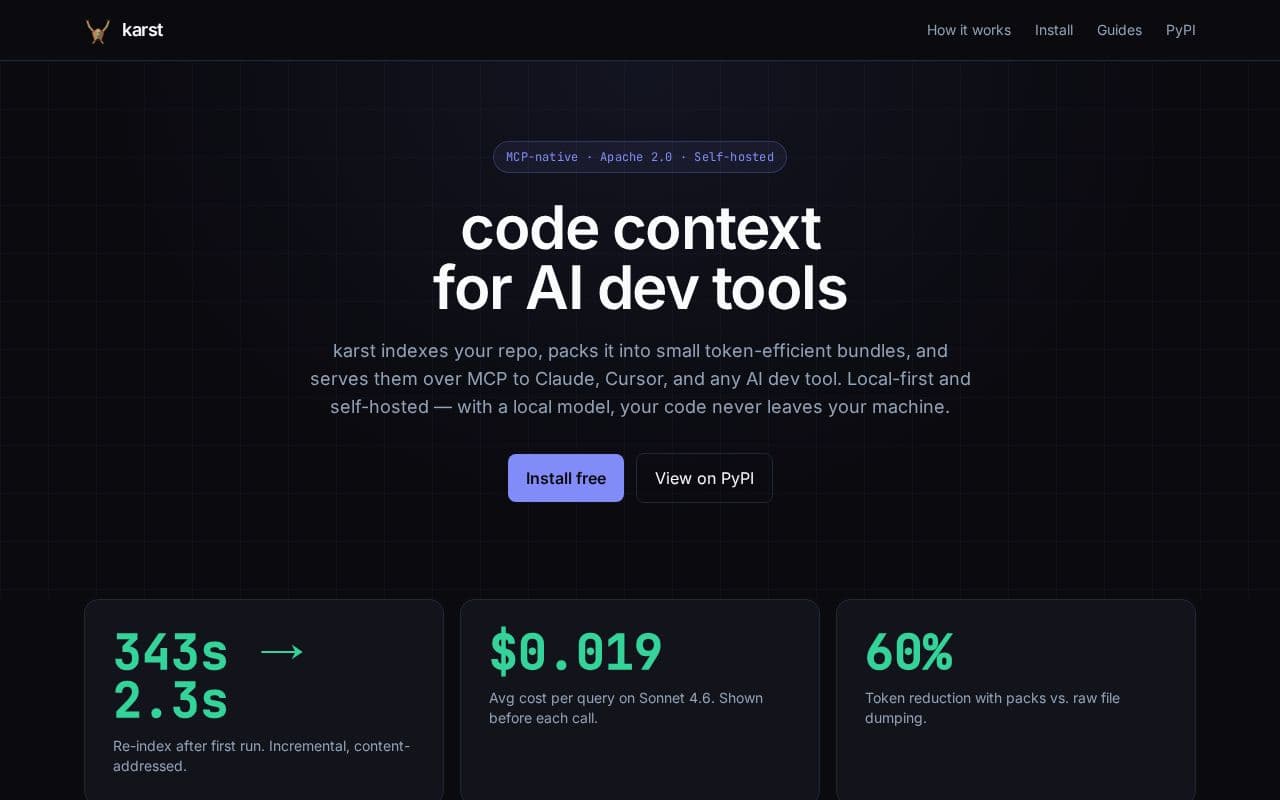
Karst begins by walking through the repository structure and parsing files to extract symbols, calls, and imports. This process creates an efficient index that updates quickly on subsequent runs by focusing only on changes. The system then suggests groupings of files that frequently interact, allowing users to organize them into named packs. These packs serve as the primary units for context provision. Finally, Karst exposes the packs through an MCP interface, enabling seamless integration with popular AI coding assistants. This approach ensures that only relevant code sections are supplied, enhancing efficiency and control over costs.
Key features
Indexes repositories with tree-sitter parsing of symbols, calls, and imports
Incremental content-addressed re-indexing after first run
Groups related files into named packs for context
Serves packs as MCP resources to AI dev tools
60% token reduction vs raw file dumping
Local-first self-hosted with optional local models
Displays query cost before each call
What you can use KARST for
Codebase Onboarding
Index a repository with tree-sitter parsing of symbols, calls, and imports, then serve grouped packs as context to quickly understand new code.
Impact Analysis
Group related files into named packs so AI tools can retrieve only the relevant bundles when exploring change effects or dependencies.
Token-Efficient Queries
Serve packs over MCP to AI dev tools instead of raw files, keeping context focused while displaying query cost before each call.
How to use KARST
- 1Install karst with pip
- 2Run karst index on the target repository
- 3Generate pack suggestions and review them
- 4Apply the chosen packs
- 5Query code or connect an MCP client
KARST pricing
Pricing model: Open Source. Plan details are indicative — check the site for current prices.
Free
Free
- Self-hosted
- Apache 2.0
- pip install karst
- Local-first
Editor's verdict
Pros
- +Fast re-indexing (2.3s after initial pass)
- +Strong privacy with air-gapped/local model support
- +No vector DB or embeddings required
Cons
- –Initial indexing can take minutes on large codebases
- –Requires manual review and tagging of suggested packs
Our take: KARST is a solid coding & dev choice. It's valued for fast re-indexing (2.3s after initial pass) and strong privacy with air-gapped/local model support. The main trade-off is initial indexing can take minutes on large codebases. A good pick if you want capable AI without a high upfront cost.
Frequently asked questions
karst is a local-first self-hosted tool that indexes code repositories and exposes grouped packs as MCP resources for AI development tools.
Summary
KARST is a solid coding & dev choice. It's valued for fast re-indexing (2.3s after initial pass) and strong privacy with air-gapped/local model support. The main trade-off is initial indexing can take minutes on large codebases. A good pick if you want capable AI without a high upfront cost.
Did you find this helpful?
User reviews
Verified reviews from the community shape this tool's rating.
Loading reviews…
KARST alternatives
Similar coding & dev tools worth comparing.


