Kyros
Kyros delivers persistent memory structures tailored for autonomous AI agents.
Open SourceProductivity
Visit website Free to browse · updated 2026-06-24
What is Kyros?
Kyros functions as a mediation layer that connects AI agents to vector and graph databases. Agents can store memories through simple API calls that handle embedding generation, hashing for integrity, and assignment of decay weights. Retrieval uses similarity search combined with retention scoring to surface only pertinent context for prompts. The architecture supports both direct SDK usage in Python and TypeScript as well as a proxy mode that intercepts requests to common LLM providers. This allows context injection without modifying existing agent code. Built-in support for the Model Context Protocol further enables integration with various development environments. Framework connectors exist for popular libraries so that memory operations occur automatically during agent execution. All stored items remain auditable through Merkle structures while the system filters out low-relevance entries based on configurable thresholds.
Key features
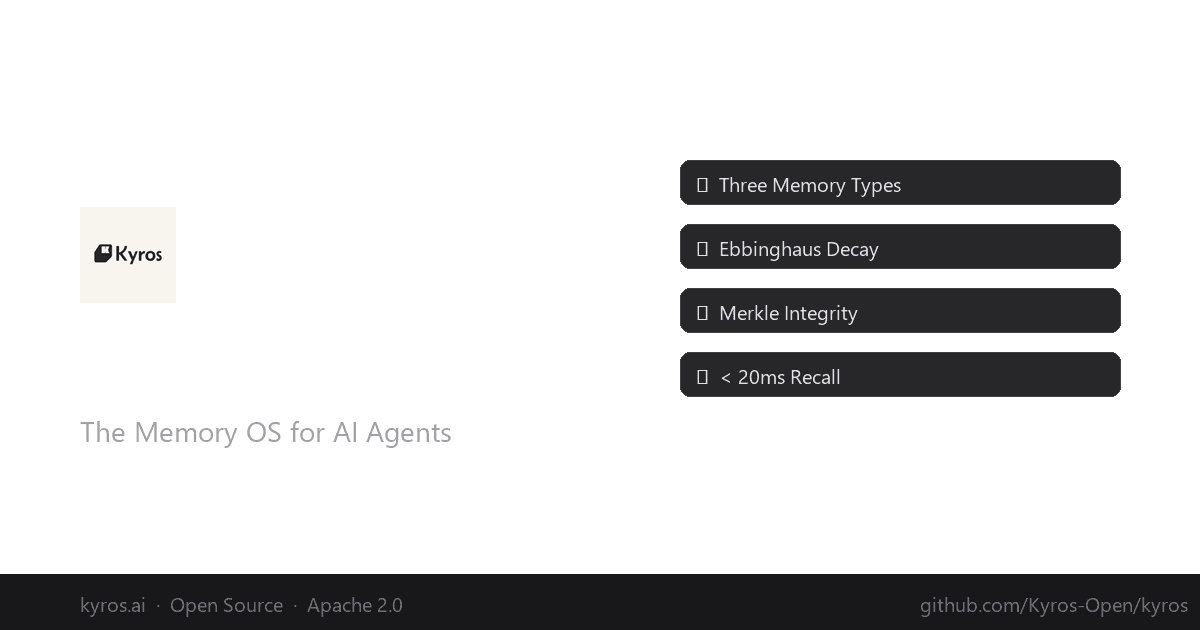
Episodic, semantic, and procedural memory types
Cryptographic integrity via Merkle trees and SHA-256
Ebbinghaus decay with temporal retention weighting
0-config auto schema migration on startup
Native Python and TypeScript SDKs
Built-in MCP server for IDE tool integration
OpenAI-compatible proxy mode for automatic context injection
What you can use Kyros for
Autonomous Agent Memory Persistence
Equip AI agents with episodic log streams, semantic graphs, and procedural workflows that retain context across sessions using Ebbinghaus decay and cryptographic auditing.
IDE Context Recall for Development
Connect Kyros to agentic IDEs via the built-in MCP server to recall memories across coding cycles without external dependencies.
LLM Prompt Context Injection
Use the OpenAI-compatible proxy to automatically retrieve and inject relevant memories into prompts for more coherent agent responses.
How to use Kyros
- 1Install the Kyros Python or TypeScript SDK
- 2Initialize the client with an API key
- 3Ingest memories using the ingest or remember call
- 4Recall relevant context with the recall function
- 5Inject retrieved memories into LLM prompts
Kyros pricing
Pricing model: Open Source. Plan details are indicative — check the site for current prices.
Apache 2.0
Free
- Permissive commercial use
- Open Source
- Py + TS Native SDKs
Editor's verdict
Pros
- +Apache 2.0 open source with permissive commercial use
- +Minimal-code integration into existing AI stacks and frameworks
- +Framework-ready with CrewAI, LangChain, and LlamaIndex support
Cons
- –Requires PostgreSQL/pgvector and Redis backend instances
- –MCP support limited to specific IDEs via stdio JSON-RPC
Our take: Kyros is a solid productivity choice. It's valued for apache 2.0 open source with permissive commercial use and minimal-code integration into existing ai stacks and frameworks. The main trade-off is requires postgresql/pgvector and redis backend instances. A good pick if you want capable AI without a high upfront cost.
Frequently asked questions
Kyros supports episodic, semantic, and procedural memory types with temporal retention weighting.
Summary
Kyros is a solid productivity choice. It's valued for apache 2.0 open source with permissive commercial use and minimal-code integration into existing ai stacks and frameworks. The main trade-off is requires postgresql/pgvector and redis backend instances. A good pick if you want capable AI without a high upfront cost.
Did you find this helpful?
User reviews
Verified reviews from the community shape this tool's rating.
Loading reviews…
Kyros alternatives
Similar productivity tools worth comparing.


